
AI training
Teach a mixed technical team to review AI summaries
Use one shared source and a claim-by-claim exercise to teach technical and nontechnical colleagues how to review AI summaries.

In this guide
Make the source document the common ground
When technical and nontechnical colleagues review an AI summary, they often notice different problems. One person checks terminology. Another notices that the proposed deadline has become a promise. Another sees that the summary omits the customer’s unresolved question. A useful training session brings those observations together.
For a Peachtree Corners team working across project and business roles, start with one short document that everyone can understand. The goal is a shared review method, not a contest to find the most sophisticated prompt. People need to agree on what makes the summary usable.
Choose a fictional or approved practice document containing a decision, a proposal, a disagreement and a missing detail. Those four elements expose the errors that a smooth paragraph can hide.
Prepare a source that rewards careful reading
Here is a fictional meeting-note pattern. The team approved the existing scope. Someone suggested a Friday delivery, but nobody confirmed it. A manager asked for a cost estimate. Two people used different names for the same project, and the owner of the next action was left open.
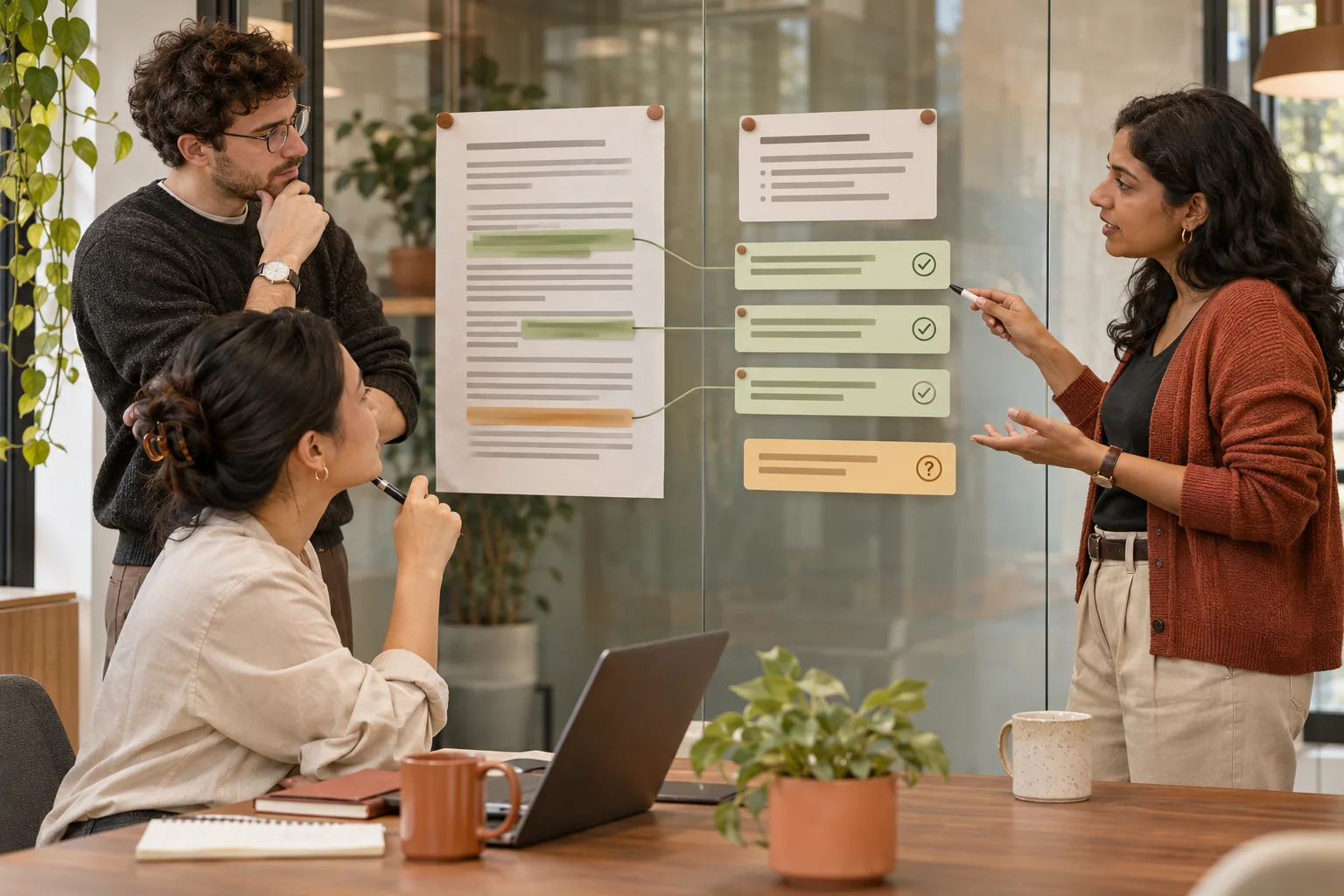
Ask the group to mark these facts before generating anything. Label confirmed decisions, proposals, open questions and unknowns. Explain that the labels describe what the source establishes. They are not a vote about what the team would prefer to happen.
Now ask an AI tool for a concise handoff summary. Keep the source beside the result. If the model turns the suggested Friday delivery into a deadline, the group has a precise example to discuss. Nobody needs programming knowledge to explain why that sentence is unsupported.
Review claims rather than overall impressions
Split the summary into individual claims. For each claim, ask which source statement supports it, whether it preserves the original level of certainty and whether it leaves out a condition that changes the meaning. “The team will deliver Friday” and “Friday was proposed” are not interchangeable.
Assign roles for the first round. One person checks factual support. Another checks missing decisions and questions. A third checks whether the result is understandable to the next person doing the work. Rotate the roles afterward so the exercise does not turn one reviewer into the permanent safety net.
Let reviewers disagree and point to the source. A disagreement about wording can reveal a genuine ambiguity in the notes. Record that ambiguity instead of forcing a confident answer. The team can improve both the summary instruction and the way it records decisions.
Teach the difference between an omission and a useful edit
A summary cannot include everything. Reviewers need to distinguish harmless compression from an omission that changes what someone will do. Removing a repeated greeting is different from removing the condition attached to an approval.
Ask each reviewer to name the reader and the decision the summary supports. A brief for an implementation colleague needs technical dependencies. A brief for a customer-facing colleague needs agreed commitments and unresolved questions. Both can use the same source while emphasizing different details.
Generate two versions for those audiences and compare them. The facts should stay consistent even when the structure changes. If the audience instruction causes the model to invent an explanation, identify the unsupported sentence and revise the instruction. Audience adaptation changes presentation, not evidence.
Use a second round to test the method
Change the practice document rather than polishing the first answer forever. Add an explicit owner, remove a date or insert a conflicting note. Ask the team to predict which parts of the summary should change before they see the new output.
This prediction step checks understanding. If participants can explain the expected change, they are learning to evaluate the process. If they only recognize errors after someone else points them out, the group needs another short practice round.
Keep a few corrected examples with explanations. “This was wrong because the source only proposed the date” teaches more than “bad summary.” Save the source, original output, correction and reason together. Later, the set can help evaluate a new tool or a revised prompt without relying on memory.
Agree on a small shared working method
End with a review checklist the team can actually use: confirm the source, identify decisions and proposals, check dates and owners, preserve important conditions, and show unresolved questions. Name the person who approves the final output for the workflow being practiced.
Decide where corrected examples live and who updates them when the process changes. A training session is more useful when its method appears beside the everyday task. A long prompt library in a separate folder is easy to forget during a busy week.
If you are preparing a workshop, our guide to choosing one shared team exercise explains what to collect beforehand. Teams considering a connected assistant can use the same review examples in a small AI pilot.
AI training for Peachtree Corners teams can focus on these shared habits. The free assessment is a starting conversation with practical training and a discussion of more focused sessions.